Skip to content

Chapter I · Life

The man before
the martyr

He is remembered for seven months in office and the manner of his death. But Lumumba’s life began long before 1960 — in a Tetela village, a mission school, a post office, a newsroom.

This biography follows him chronologically, through the education he largely gave himself, the colonial city that radicalised him, the party he built and the government he led — so that the end can be understood in the light of everything that came before it.

01 · 1925 — 1940s

Early life and education

Onalua, Sankuru · Kasai

He was born on 2 July 1925 in Onalua, a village in the Katako-Kombe territory of Sankuru, in the Kasai province of the Belgian Congo, and named Élias Okit’Asombo. His father, François Tolenga Otetshima, was a farmer; his mother was Julienne Wamato Lomendja. The family was Tetela, a people of the forest and savannah between the Sankuru and Lomami rivers.

He went to a Protestant mission primary school and then a Catholic mission school — the only kinds of schooling most Congolese could reach. Belgian colonial education was built to produce catechists, clerks and skilled workers, not leaders: secondary schooling was scarce, and at independence fewer than twenty Congolese held university degrees.

Lumumba made up the difference himself. He read voraciously — history, French literature, political philosophy — and began to write. That habit of self-education, and the conviction that a colonised man could argue with the coloniser in his own language, ran through everything that followed.

  • Born Élias Okit’Asombo
  • Tetela heritage
  • Mission-educated, largely self-taught
02 · 1940s — 1957

Early career and political awakening

Léopoldville · Stanleyville

After a one-year course at the colonial post-office training school in Léopoldville, he was posted to Stanleyville (today Kisangani) as a postal clerk. There he became a prominent évolué — the colonial term for Africans with a European-style education — joining the city’s associations, a staff union and its debating circles.

He wrote for the évolué press, including La Croix du Congo and La Voix du Congolais, and saw at close range how the colony worked: separate quarters, separate wages, separate justice. His early politics were reformist — equal pay, an end to the colour bar, a Belgo-Congolese partnership — and in 1956 he toured Belgium on a study trip organised by the Ministry of Colonies.

That year he was arrested for embezzling post-office funds and spent about a year in prison. In this period he wrote a book-length manuscript on the colony’s future, published after his death as Le Congo, terre d’avenir, est-il menacé? On his release in 1957 he moved to Léopoldville to sell beer for the Bracongo brewery — a job that took him into every bar and neighbourhood of the capital, and taught him how to speak to a crowd.

  • Postal clerk, Stanleyville
  • Writer in the évolué press
  • Study trip to Belgium, 1956

03 · 1958 — 1959

The birth of Congolese nationalism

Léopoldville · Accra · Stanleyville

On 5 October 1958 Lumumba and a group of Léopoldville évolués founded the Mouvement National Congolais. Unlike ABAKO, which spoke for the Bakongo of the lower Congo, or the regional parties then forming in Katanga and Kasai, the MNC set out to recruit across every province and people. Lumumba became its president and its voice.

In December 1958 he travelled to Accra for Kwame Nkrumah’s All-African Peoples’ Conference — his first meeting with the leaders of liberation movements from across the continent. He came home with a Pan-African vocabulary and a demand: independence, not reform. His report-back rally in Léopoldville on 28 December drew thousands.

A week later, on 4 January 1959, Léopoldville erupted after the authorities banned an ABAKO meeting; dozens were killed. On 13 January King Baudouin promised independence ‘without fatal delay’. When the MNC split in July 1959 — Albert Kalonji’s wing against Lumumba’s, the MNC-L — Lumumba kept the national line. After riots at an MNC congress in Stanleyville in October 1959 he was arrested and, in January 1960, sentenced to six months.

  • MNC founded 5 October 1958
  • Accra, December 1958
  • Imprisoned November 1959
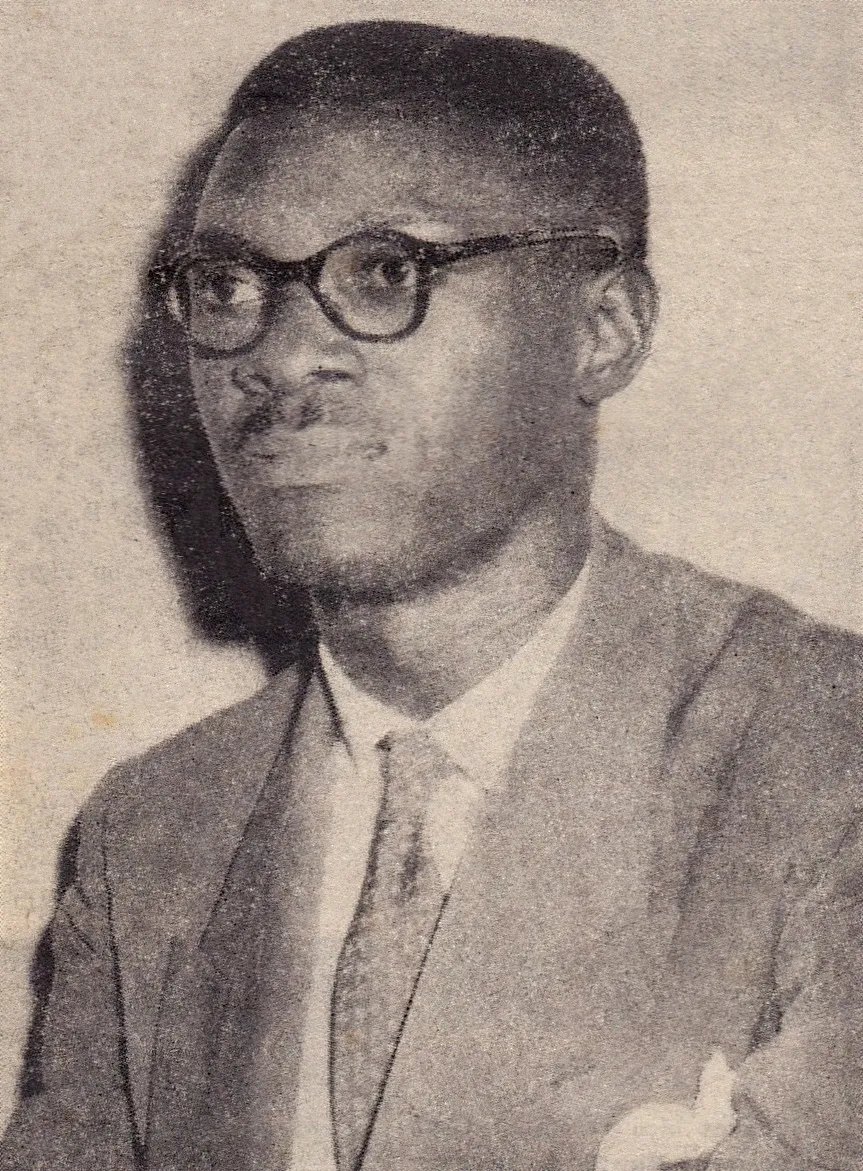
Head-and-shoulders portrait of Patrice Lumumba in glasses, jacket and tie, 1958
Lumumba as pictured in Présence Congolaise, 4 October 1958 — the eve of the MNC’s founding.Présence Congolaise · public domain

04 · 1960

The road to independence

Brussels · Léopoldville

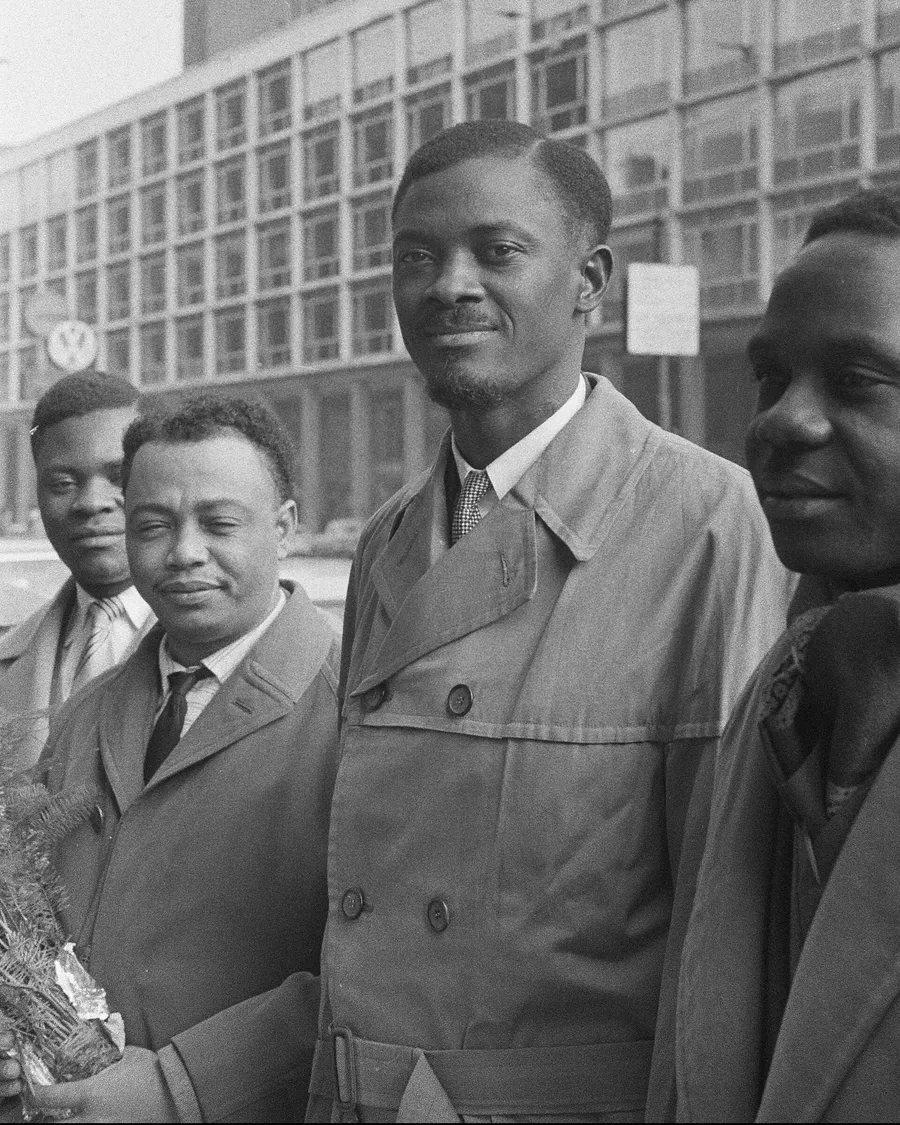
The Round Table conference opened in Brussels on 20 January 1960. The Congolese delegations refused to negotiate without Lumumba; he was freed and flown to Brussels, arriving on 26 January. On 20 February the conference closed with a date for independence: 30 June 1960. ‘We demanded the immediate and unconditional independence of our country,’ he told it. ‘We have just won it.’

In the May 1960 elections the MNC-L and its allies won the largest bloc in the Chamber of Representatives — and the MNC-L was the only party with strong support in several provinces at once. On 23 June parliament approved his government; the next day it elected his rival, Joseph Kasa-Vubu of ABAKO, head of state.

On 30 June, at the Palais de la Nation in Léopoldville, the Congo became independent. Lumumba — Prime Minister and Minister of National Defence — was thirty-four.

  • Round Table, Brussels
  • May 1960 elections
  • Prime Minister at 34
Patrice Lumumba in a raincoat with Congolese delegates on a Brussels street, January 1960
With fellow delegates in Brussels after his release, 26 January 1960.Harry Pot / Anefo · Nationaal Archief, CC0

05 · June — September 1960

Prime Minister of the Congo

Léopoldville

Lumumba inherited a state whose army, administration and economy were still run by Belgians. Within a week the Force Publique mutinied against its Belgian officers. He answered by Africanising the officer corps — Victor Lundula as commander, Joseph-Désiré Mobutu as chief of staff — while Belgium sent in troops without the government’s consent.

On 11 July Moïse Tshombe declared Katanga, the copper province, independent, with Belgian military and corporate backing; in August South Kasai followed. Lumumba and Kasa-Vubu appealed to the United Nations, which sent a peacekeeping force but would not use it to end the secession. Lumumba then turned to the Soviet Union for transport for an offensive towards Kasai and Katanga — a campaign marked by the killing of Luba civilians in South Kasai.

His relationship with Kasa-Vubu, a cautious federalist, broke down. On 5 September the President announced Lumumba’s dismissal; Lumumba replied by dismissing the President, and parliament refused to endorse either decision.

  • Mutiny, 5 July
  • Katanga secession, 11 July
  • UN force arrives, 15 July
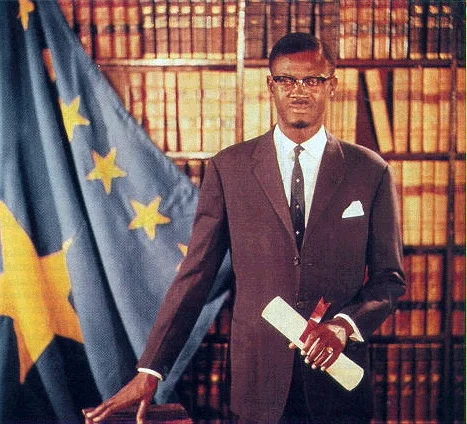
Colour portrait of Prime Minister Lumumba standing before the blue flag with a yellow star, holding a rolled document
Official portrait as Prime Minister, 1960, before the flag of the new republic.Government of the Republic of the Congo · public domain

06 · 1960 — 1961

Overthrow, arrest and assassination

Léopoldville · Thysville · Élisabethville

On 14 September 1960 Colonel Mobutu seized power and ‘neutralised’ the politicians. Lumumba was confined to his residence, encircled by UN troops on the inside and Mobutu’s soldiers on the outside. On the night of 27 November he slipped out and headed east for Stanleyville, where his supporters held power.

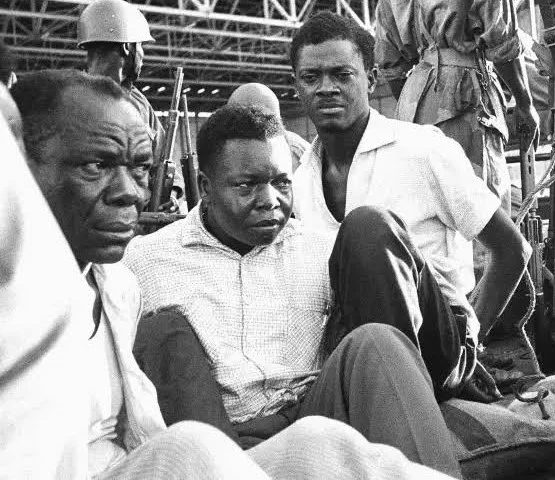
Mobutu’s soldiers caught him on 1 December near the Sankuru river. He was flown back to Léopoldville, beaten in front of news cameras, and imprisoned at Camp Hardy in Thysville. On 17 January 1961 he was flown with two companions — Maurice Mpolo, his Minister of Youth and Sport, and Joseph Okito, Vice-President of the Senate — to Élisabethville, the capital of secessionist Katanga.

That night all three were shot by a firing squad, in the presence of Katangan ministers and Belgian officers. Days later, Belgian policemen dug up the bodies, cut them apart and dissolved them in acid. Katanga announced his death only on 13 February, with an invented story of escape and murder by villagers.

  • Coup, 14 September 1960
  • Captured, 1 December 1960
  • Killed, 17 January 1961
Lumumba, in a white shirt, sitting on the floor of a truck with two other detainees, guarded by soldiers
Lumumba (right) after his capture, December 1960.Associated Press · public domain (copyright not renewed)