Chapter II · The road to independence
The birth of
a free Congo
Seventy-five years separate Leopold II’s Free State from the Republic of 30 June 1960. Lumumba’s movement covered the last stretch in under two.
The timeline below runs from the Free State’s rubber regime, through the Belgian Congo, to the movements, conferences and elections that ended colonial rule. Filter it by period.
Colonial rule
1885
The Congo Free State
In the era of the Berlin Conference, the Congo basin is recognised as the personal possession of King Leopold II of the Belgians — not a Belgian colony, but one man’s ‘État indépendant du Congo’.
Colonial rule
1890s — 1908
The rubber regime
To meet quotas for wild rubber and ivory, villages are subjected to forced labour, hostage-taking, flogging and mutilation by the Force Publique and concession companies. The death toll is debated by historians; that the population fell catastrophically is not.
Colonial rule
1904
The Casement Report
British consul Roger Casement documents the atrocities; with E. D. Morel’s Congo Reform Association, it turns the Free State into an international scandal.
Colonial rule
1908
The Belgian Congo
Under pressure, Belgium annexes the territory. The Free State becomes the Belgian Congo, governed from Brussels for the next fifty-two years.
Colonial rule
1908 — 1950s
State, Church and company
The colony is run by an alliance of administration, missions and mining companies such as the Union Minière du Haut-Katanga. Forced cultivation, a colour bar in cities, and a paternalist policy that offers Africans primary schooling but no political rights.
The movement
1955 — 1956
The first demands
A Belgian professor, A. A. J. Van Bilsen, proposes a thirty-year plan for emancipation. The Catholic évolués of Conscience Africaine call for a gradual path; ABAKO, the Bakongo association led by Joseph Kasa-Vubu, replies by demanding independence now.
The movement
December 1957
The first elections
Congolese vote for the first time, in municipal elections in Léopoldville, Élisabethville and Jadotville. ABAKO sweeps the capital.
The movement
August 1958
Across the river
In Brazzaville, facing Léopoldville across the Congo river, Charles de Gaulle offers France’s African colonies a vote on their future. The contrast with Belgian silence is not lost on Léopoldville.
The movement
5 October 1958
The MNC is founded
The Mouvement National Congolais sets out to be what no party yet is: national, recruiting in every province. Lumumba becomes its president.
The movement
5 — 13 December 1958
All-African Peoples’ Conference, Accra
Lumumba joins Nkrumah’s gathering of liberation movements from across the continent, and returns to demand immediate independence at a mass rally in Léopoldville.
The movement
January 1959
The Léopoldville riots
After an ABAKO meeting is banned on 4 January, the capital erupts; the official toll is 49 dead, and other estimates are far higher. On 13 January King Baudouin promises independence ‘without fatal delay’.
Independence
20 January — 20 February 1960
The Brussels Round Table
Congolese parties, united as a common front, win their demand: Lumumba is released to attend, and independence is set for 30 June 1960 — barely four months away.
Independence
April — May 1960
The economic Round Table
A second conference settles economic and financial questions. Most party leaders are campaigning at home and send young advisers; the colony’s economic power stays largely where it was.
Independence
19 May 1960
The Loi fondamentale
Belgium passes the provisional constitution of the new state: a parliamentary system with a head of state and a Prime Minister — a division of power that will break within months.
Independence
May 1960
The national elections
The MNC-L and its allies win the largest bloc in the Chamber. On 23 June parliament approves Lumumba’s government; on 24 June it elects Kasa-Vubu President.
Independence
30 June 1960
Independence
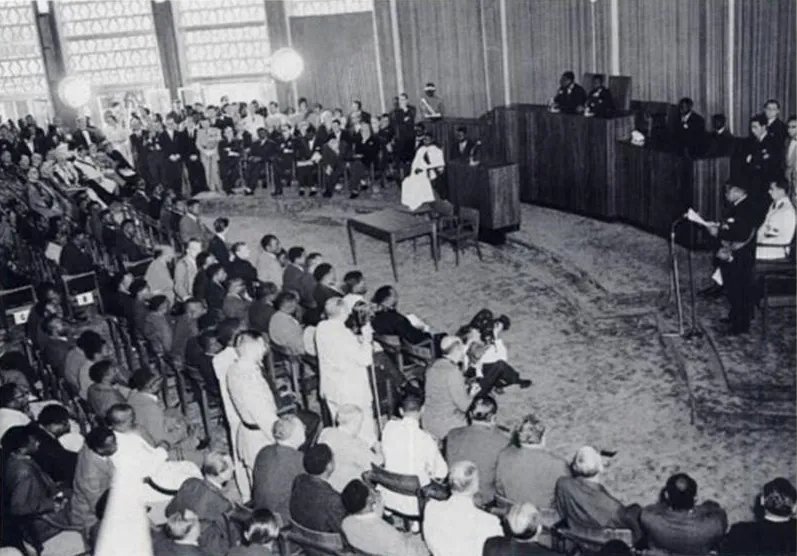
The Republic of the Congo is proclaimed at the Palais de la Nation in Léopoldville, in the presence of King Baudouin.
Palais de la Nation, Léopoldville · 30 June 1960
The speech
the King heard
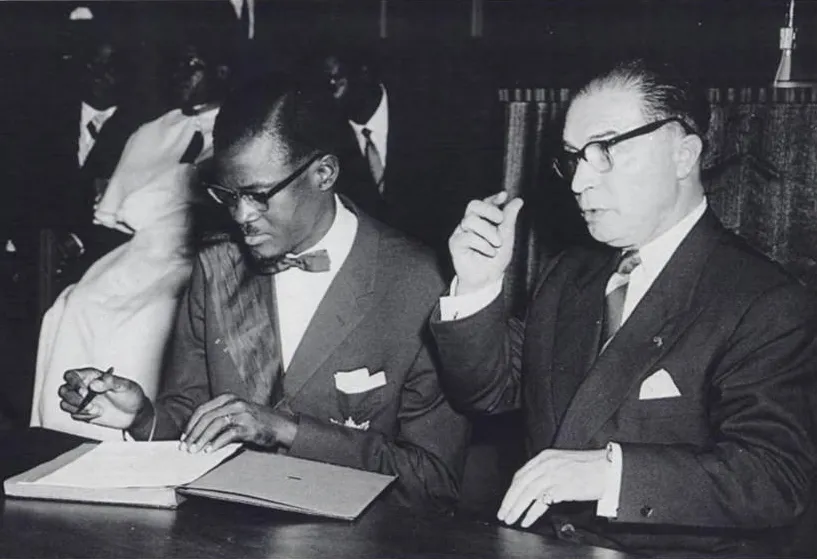
King Baudouin spoke first. ‘The independence of the Congo,’ he began, ‘is the crowning of the work conceived by the genius of King Leopold II.’ President Kasa-Vubu replied with a courteous address. Then Lumumba — not on the official programme — rose to speak, not to the King but to ‘Congolais et Congolaises, combattants de l’indépendance aujourd’hui victorieux’.
The speech was broadcast live and repeatedly interrupted by applause. Belgian officials took it as an insult; Lumumba offered a more conciliatory toast at lunch later that day. But the words had been said, and they travelled across Africa.
Original · French
« Nous avons connu le travail harassant, exigé en échange de salaires qui ne nous permettaient ni de manger à notre faim, ni de nous vêtir ou nous loger décemment, ni d’élever nos enfants comme des êtres chers. »
We have experienced forced labour in exchange for pay that did not allow us to satisfy our hunger, to clothe ourselves, to have decent lodgings or to bring up our children as dearly loved ones.
« Nous avons connu les ironies, les insultes, les coups que nous devions subir matin, midi et soir, parce que nous étions des nègres. »
Morning, noon and night we were subjected to jeers, insults and blows because we were “Negroes”.
« Nous avons connu que la loi n’était jamais la même selon qu’il s’agissait d’un blanc ou d’un noir : accommodante pour les uns, cruelle et inhumaine pour les autres. »
We have not forgotten that the law was never the same for the white and the black, that it was lenient to the ones, and cruel and inhuman to the others.
« Ensemble, mes frères, mes sœurs, nous allons commencer une nouvelle lutte, une lutte sublime qui va mener notre pays à la paix, à la prospérité et à la grandeur. »
Brothers, let us commence together a new struggle, a sublime struggle that will lead our country to peace, prosperity and greatness.
French text: La pensée politique de Patrice Lumumba, ed. Jean Van Lierde (Présence Africaine, 1963). English: The Truth about a Monstrous Crime of the Colonialists (Moscow, 1961), via the Marxists Internet Archive’s full text.
Why it mattered
- 1
It named the colonial experience
Baudouin had praised the ‘genius’ of Leopold II. Lumumba answered, before the King and the world’s press, with an inventory of what colonial rule had meant for those who lived under it: forced labour, the whip, the colour bar, land taken by law.
- 2
It claimed independence as a victory
Independence, he said, had not been a gift: ‘no Congolese will ever forget that independence was won in struggle’. The Congolese people were its authors, not its recipients.
- 3
It looked forward
Most of the speech is a programme — social justice, fair wages, the end of discrimination, the land for its people, national unity above ‘tribal quarrels’, and the Congo as ‘a decisive step towards the liberation of the whole African continent’.